

Coordonnées :
+86 17852488518

Product Overview
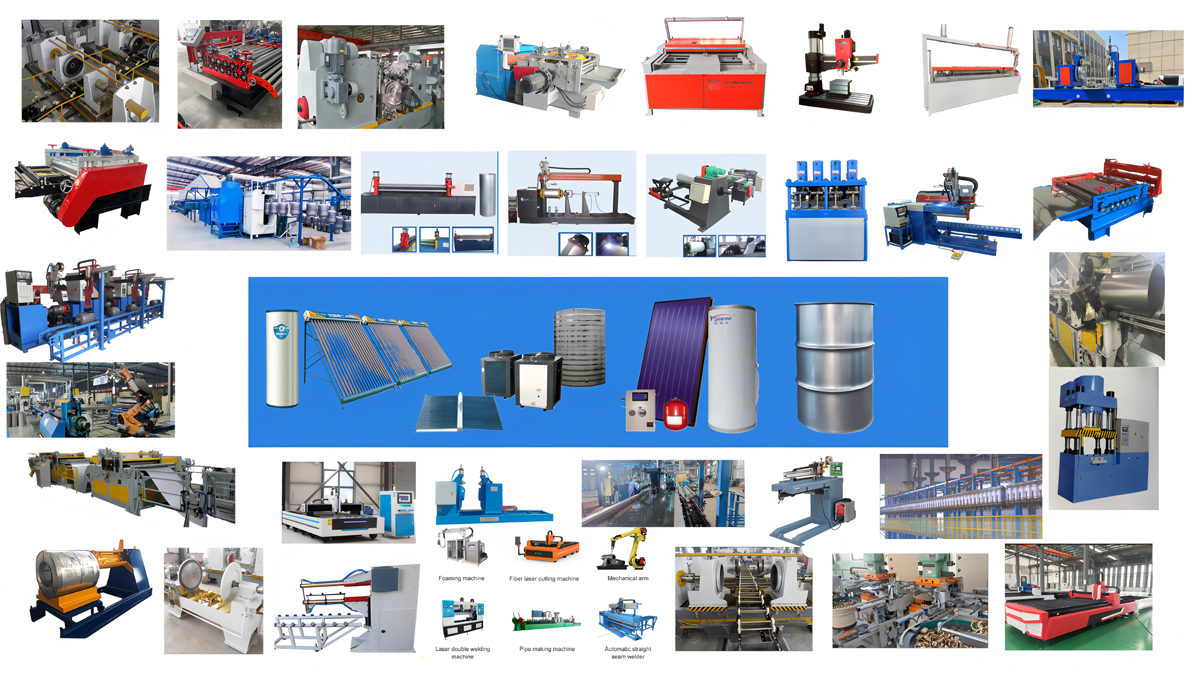
The four-column press is an important hydraulic forming equipment in Steel Drum Production Lines, mainly used for stamping, stretching, forming, and shaping of steel drum lids, bottoms, and other metal drum components. The equipment adopts a high-strength four-column frame structure, equipped with a hydraulic power system, precision forming dies, and a PLC control device, featuring uniform force distribution, stable operation, and high forming accuracy. Different nominal pressures, worktable sizes, slide strokes, and die configurations can be customized according to the production requirements of 200L steel drums, chemical drums, oil drums, and other metal packaging containers of various specifications. The equipment can meet the needs of different sheet thicknesses and forming processes by adjusting the hydraulic pressure, pressing speed, and working stroke. It can also be configured with automatic feeding, unloading, and conveying systems to achieve continuous production. The four-column press has advantages such as robust structure, convenient operation, simple maintenance, and strong adaptability. It can be used in conjunction with shearing, stamping, rolling, welding, and sealing equipment in steel drum production lines to improve the processing efficiency of steel drum components and product consistency.


Let me tell you about a question I get all the time from steel drum factory owners: “Why do I need a four-column hydraulic
press when I already have a mechanical punch press?” It’s a fair question. Both machines stamp metal. But after watching
hundreds of drum lids and bottoms being formed, I can tell you there’s a world of difference between the two. And once you
understand what a four-column press can do, you’ll never look at your stamping operation the same way.
A four-column hydraulic press gets its name from its structure: four vertical guide columns connecting an upper beam, a
sliding block, and a workbench. That four-column design is what gives the press its rigidity and alignment accuracy. When
you’re stamping steel drum lids, you need the die and the workpiece to line up perfectly every time. Any flex in the press
frame, and your parts come out with inconsistent thickness or off-center features. The four-column setup minimizes that flex,
which means better quality parts and longer die life.
In steel drum production, this press does several critical jobs. The main one is blanking and drawing the bottom and top lids
from steel sheet. It also does flanging the lid edge, pressing identification marks, and installing closure flanges. A 60-ton press
is common for lid marking and flange installation, while larger presses—160-ton, 250-ton, or even 500-ton—handle the actual
lid stamping and deeper drawing operations.
So what makes a four-column hydraulic press different from a mechanical press? The main difference is the drive. Hydraulic
presses use fluid pressure to push the ram. That gives you better control over the stroke, so you can adjust the force and
speed on the fly. That matters because different steel thicknesses need different forming speeds. If you run too fast, you risk
cracking the metal. If you run too slow, you waste cycle time. A hydraulic press lets you dial in the exact speed for your
material.
Another advantage of hydraulic presses is the ability to hold the force at the bottom of the stroke. This is called dwell time,
and it’s important for deep drawing operations. The press can maintain pressure for a fraction of a second, which helps the
metal form completely before the ram retracts. Mechanical presses can’t do that—they’re either at the top or the bottom
of the stroke, with no in-between.
When you’re evaluating a four-column press for steel drum production, look at these specs. First, the force capacity. The
machine’s tonnage needs to match your forming requirements—for steel drum lids, the 160-ton range is common. Second,
the bolster (worktable) size. Your press needs to accommodate the largest die set you’ll be using. Third, the stroke length.
For deep drawing operations, you need enough stroke to pull the material into the die without bottoming out.
Here’s a practical tip: look for a press with adjustable stroke speed and pressure settings. You’ll be running different steel
thicknesses—0.8mm to 1.5mm—and those need different forming parameters. A press where you can save multiple recipes
is far more practical than one where you have to manually adjust each time.
Also, make sure the press has a good hydraulic system. The best ones use cartridge valve integrated systems, which have
fewer leak points and are more reliable than traditional piped systems. And invest in a press with a good cooling
system—hydraulic fluid heats up during extended production runs, and overheating can damage the pumps and seals.
Your four-column hydraulic press may not be the first machine visitors notice when they walk through your factory, but it’s
the machine that makes the parts that hold your drums together. Get it right, and you’ll produce consistent, high-quality
lids and bottoms for years. And in the steel drum business, that kind of consistency is what builds a reputation worth keeping.
 RELATED


Ce site Web utilise des cookies pour vous garantir la meilleure expérience sur notre site Web.


 English
 Español
 Pусский
 العربية



 Téléphone