

Coordonnées :
+86 17852488518

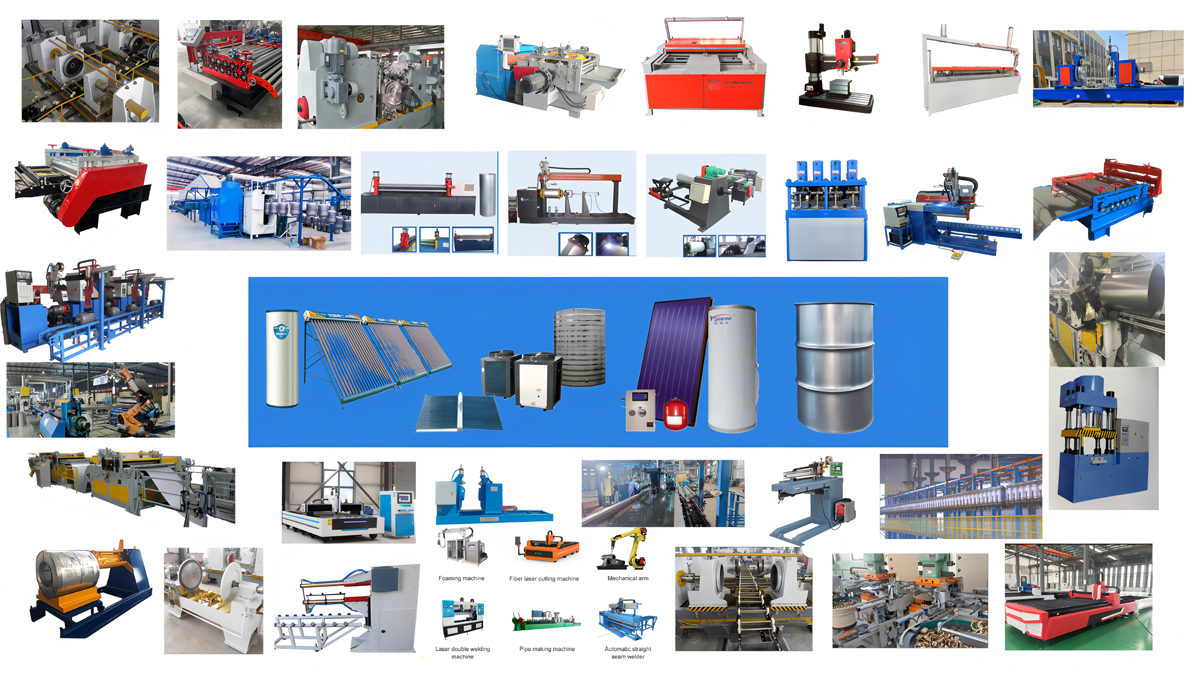
Product Overview
This straight seam welding machine (seam welding machine) is a core piece of equipment in Steel Drum Production Lines,
used for continuous resistance welding of the straight seam joints of rolled drum bodies. It employs upper and lower
electrode rollers to apply pressure and welding current to the overlapping area. The heat generated by the contact
resistance melts the overlapping edges, forming a series of overlapping weld points, thus obtaining a continuous, dense,
and airtight longitudinal weld. The equipment consists of a main unit, a welding power supply (optional AC or
medium-frequency inverter DC power supply), a cooling system, an electrode trimming mechanism, a PLC control system,
and an automatic loading and unloading mechanism.
Main equipment parameters: Applicable barrel diameter Φ300~Φ560mm, barrel length 600~1000mm, steel plate thickness
0.6~1.5mm, welding speed 3~8m/min (steplessly adjustable), welding machine capacity 150~600KVA, overlap width 4~6mm,
secondary voltage 2~12V, electrode pressure 3~8kN (automatically adjusted according to material thickness and welding
speed), cooling water flow rate ≥30L/min, electrode wheel diameter Φ250~Φ350mm. Welding quality indicators: weld
tensile strength not less than 90% of the base metal tensile strength; no leakage after drop test (three drops from a height of
1.2m) and water/air pressure test.
The control system adopts a PLC and industrial touch screen, featuring digital setting and real-time display functions for
parameters such as welding current, welding speed, and electrode pressure. It can pre-store multiple sets of welding
specifications (adapting to rapid switching between different materials, thicknesses, and barrel types), and has real-time
welding quality monitoring and automatic alarm functions. The equipment can be equipped with an automatic rolling and
feeding device and a barrel joint guiding and centering mechanism to ensure that the rolled barrel automatically enters the
welding machine and completes welding. It can also be equipped with a medium-frequency inverter DC welding power
supply, which features a high power factor, stable welding quality, low secondary circuit heating, and a 3-5 times longer
electrode lifespan. It is suitable for welding special materials such as galvanized barrels and stainless steel barrels. The
machine boasts a rigid structure, smooth transmission, and simple operation, making it a crucial piece of equipment for
steel barrel manufacturers to ensure the welding strength and sealing reliability of the barrel body.


I once walked into a steel drum factory where the production manager was pulling his hair out. His rejection rate ha jumped from 1 percent to 7 percent in a single week. Drums that looked fine on the outside were failing the leak test. Some had tiny pinholes along the weld seam. Others had welds that were strong in some spots and weak in others.
After hours of troubleshooting, we traced the problem back to one machine: the steel drum seam welding machine.
The electrode wheels had worn unevenly, and nobody had noticed until the leak tester started rejecting drums.
If you're in the steel drum business, you know that the straight seam weld—the long weld that runs from top to bottom of
the drum body—is one of the most critical joints on the entire container. It's not just holding the drum together during
manufacturing. It's the weld that has to survive shipping, stacking, and handling. And when it fails, it fails spectacularly.
You don't get a slow drip with a seam weld failure. You get a split that empties the drum's contents onto the warehouse floor.
Now, if you're looking at steel drum seam welding machines, you'll notice there are two main categories: semi-automatic and
fully automatic. A semi-Automatic Seam Welder requires an operator to place the rolled drum body onto the welding
mandrel, start the weld cycle, and remove the finished drum. It's a perfectly good machine for a factory producing maybe
100 to 200 drums a day. The operator can inspect each body before welding, catch any issues early, and adjust the machine
if something doesn't look right. The downside is that the weld quality depends partly on how carefully the operator
positions the drum body and how consistently they monitor the weld.
A fully automatic seam welding machine, on the other hand, handles the entire process from start to finish. The drum body
comes in from the curling machine, gets positioned automatically, the weld cycle runs, and the welded drum comes out the
other side. There's no manual loading or unloading. The welding parameters—current, pressure, speed—are controlled by
a PLC and maintained within tight tolerances. If you're running a high-volume line producing 300 or more drums a day,
this is the kind of machine you need. It eliminates the human error that can creep into semi-automatic operation, and it
gives you consistent weld quality shift after shift.
Here's what a lot of people get wrong about seam welding machine selection: they think the power rating is the most
important spec. Sure, a higher KVA rating gives you more welding current, which helps with thicker steel. But what matters
just as much—and what most buyers overlook—is the electrode wheel design and cooling system. The electrode wheels
are what carry the welding current into the drum body. If they overheat, they lose their conductivity, and the weld quality
drops. A good seam welder will have a water-cooling system that circulates coolant through the electrode shafts to keep
them at a stable temperature. Some machines also have a wheel dressing system that cleans the electrode surfaces
continuously, preventing the buildup of oxide that can cause welding defects.
Another factor that makes a big difference in daily operation is how easy it is to adjust the welding parameters. When you
switch from one steel thickness to another—say from 0.8mm to 1.2mm—you need to adjust the welding current, wheel
pressure, and welding speed. A well-designed machine will have a control panel that lets you store and recall different
parameter sets. That way, you're not dialing in settings from scratch every time you change material. You just select the
recipe for that steel thickness, and the machine does the rest.
One more thing I always look for when evaluating a steel drum seam welder: the weld overlap. The machine should produce
a weld with an overlap of about 4 to 6 millimeters, depending on the drum size. That overlap is what gives the weld its
strength. Too little overlap, and the weld can split under pressure. Too much overlap, and you're wasting material. A good
machine will maintain that overlap consistently, drum after drum.
Here's a practical tip from my time in the field: if you're running a semi-automatic welder, set up a simple visual inspection
station right after the machine. Have an operator inspect the weld seam on every fifth drum or so, checking for pinholes,
burns, or inconsistent weld width. That quick check catches problems early, before they turn into a full-scale quality issue.
And if you're running a fully automatic welder, make sure your control system has a weld monitor that detects variations in
current or wheel speed. Those small deviations are often the first sign that the electrode wheels need dressing or the
cooling system needs attention.
At the end of the day, your steel drum seam welding machine is one of the most important pieces of equipment on your
production line. It's the machine that turns a flat piece of metal into a strong, sealed container. And if it's not running at its
best, you're going to have problems that show up in the leak tester, in the customer's complaints, and in your bottom line.
So take the time to understand what makes a good seam welder, choose the right one for your production volume, and
maintain it like the critical asset it is.
 RELATED
 RELATED


Ce site Web utilise des cookies pour vous garantir la meilleure expérience sur notre site Web.


 English
 Español
 Pусский
 العربية



 Téléphone