

Coordonnées :
+86 17852488518

Product Overview
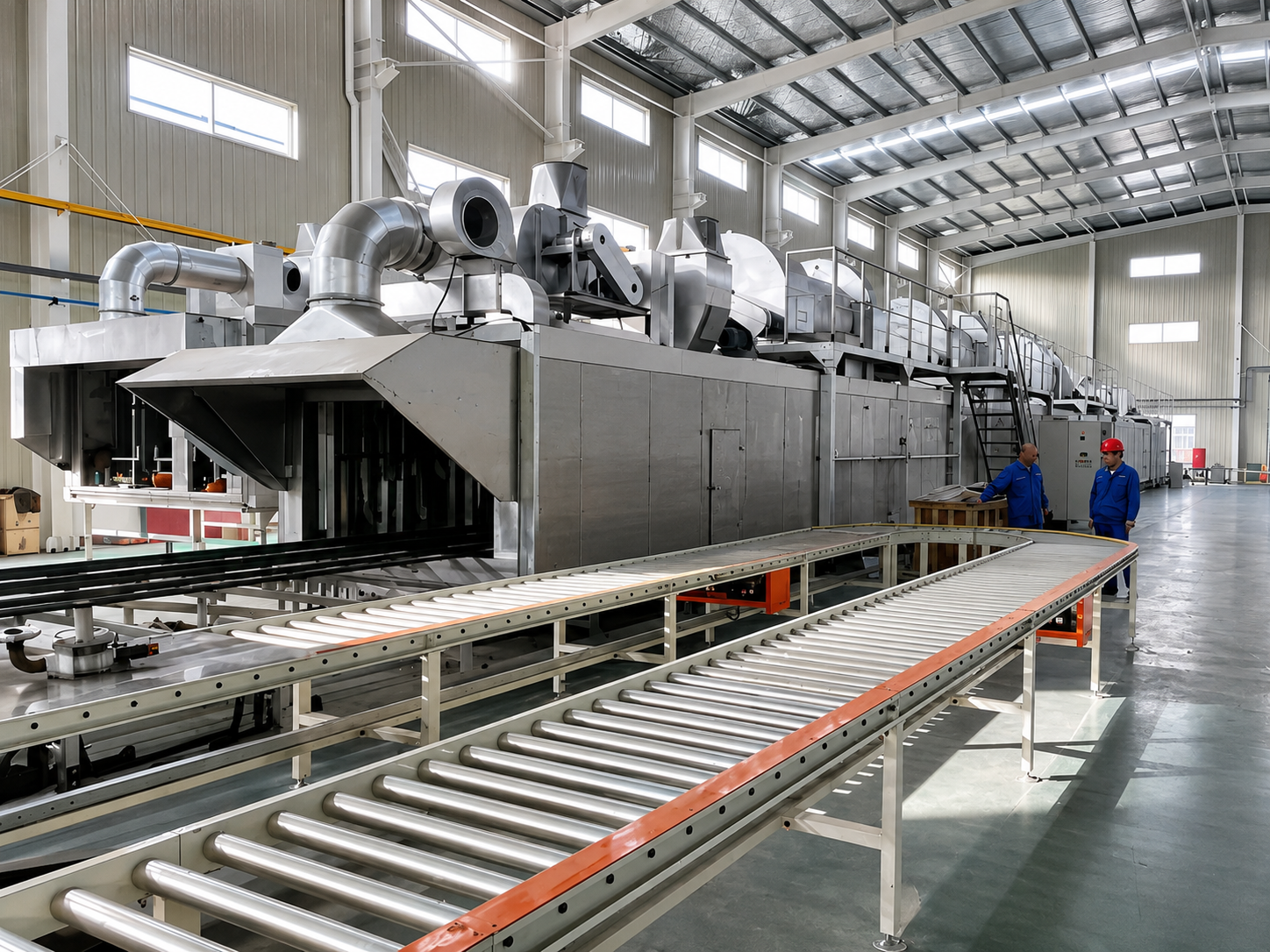
This drying production line is the core downstream equipment in the steel drum coating process. It is used to bake and cure
the coated steel drums at high temperatures, ensuring the paint film achieves the designed hardness, adhesion, and
corrosion resistance. The production line adopts a continuous through-flow hot air convection heating structure. The
furnace body is assembled from prefabricated rock wool insulation panels and equipped with a top-mounted or side-mounted
hot air circulation system and specially designed nozzles to ensure uniform temperature distribution within the furnace.
Heating methods include direct combustion of natural gas, oil, or electric heating. The operating temperature range is from
room temperature to 180°C, and multiple independent temperature control zones are set to adapt to the curing process
requirements of different paint formulations (solvent-based or water-based paints).
The furnace length and holding time are flexibly designed according to production capacity and paint type. The standard
configuration matches a production cycle of 6-10 drums/minute. The transmission system uses chain or stepper conveyors
to smoothly transport the steel drums through each heating zone. The furnace temperature is automatically adjusted by a
PID intelligent temperature controller, with a temperature control accuracy of ±3°C. Optional exhaust gas treatment
equipment (RTO/TAR) can be added to treat volatile organic solvents released during the baking process, achieving environmentally
friendly emissions.
A forced cooling zone (air-cooled or water-cooled) can be configured at the oven outlet to reduce the temperature of the steel
drums to a safe range, preventing negative pressure buildup inside the drums that could cause deformation or difficulty in
opening during filling. The entire line is centrally controlled by a PLC and operates in conjunction with the paint booth and
conveyor system, making it a key piece of equipment for steel drum manufacturers to achieve high-quality coating and curing.


Let me start by telling you about a call I got from a factory manager a few years back. He had just installed a brand-new spray
booth, hired experienced painters, and was using top-quality paint. But his drums kept coming out with bubbles and peeling
coatings. After weeks of troubleshooting, we finally figured it out: his drying oven wasn’t doing its job. The paint looked dry
on the outside, but underneath, the solvents were still trapped. A few days in the sun, and those drums were a mess. That’s
when I learned that a Steel Drum Production Line’s drying and curing system isn’t just an afterthought—it’s where the
paint job actually becomes permanent.
So here’s the thing. When you paint a steel drum, you’re not just putting color on metal. You’re applying a liquid that
needs to go through a chemical transformation to become a solid, protective film. That transformation only happens at the
right temperature, for the right amount of time. And that’s exactly what a curing oven does—it bakes the coating so it hardens,
bonds to the steel, and resists corrosion. In the steel drum industry, we often call this entire stage the drying line or curing
line, and it usually follows right after the spray booth in the production flow .
Now, if you’re looking at curing ovens for your steel drum line, you’ll run into a few different types. The most common one
is the convection oven. This type uses hot air circulating around the drums to transfer heat evenly. Koenig & Bauer, for example,
designs their drum ovens with special injection nozzles that circulate the hot air several times more than the fans actually
deliver . That means faster heat-up and better temperature uniformity, which is crucial when you’re running hundreds of
drums an hour. The temperature accuracy matters because different paints cure at different temperatures. Some solvent-based
paints need high heat; water-based ones need careful control to avoid blistering .
The other type you might hear about is the infrared oven. Instead of hot air, it uses radiant heat to cure the coating directly.
There’s an ongoing debate in the industry about which is better, and honestly, it depends on your line speed and the paints
you’re using. If your production is stop-start—like when you’re changing coils frequently—an infrared oven might be more
practical because it can be shut off quickly without wasting energy . But for continuous, high-volume production, convection
ovens are generally more energy-efficient and produce a better surface finish. One thing I’ve learned from helping factories
choose their ovens is that you have to match the oven to your real production conditions, not just pick what’s cheapest
upfront.
Now, let me give you a practical checklist from what I’ve seen work in real factories. First, decide between a single-row and
a multi-row oven. If you’re running 4 to 6 drums per minute, a single row might be enough. But if you’re pushing 8 to 10,
you’ll want a double-row or even a triple-row tunnel to keep up . Second, pay close attention to the cooling section after the
oven. This is something a lot of people overlook until it causes problems. If the drums come out hot and you close them up
right away, the air inside cools and creates a vacuum. That vacuum can collapse the drum or make it hard to open at the
filling station. A good design includes a forced cooling zone that brings the drum temperature down before it goes to the
closing station . I’ve seen factories install multi-stage coolers with high-volume air circulation just to avoid this issue.
Third, think about what fuel you have available. Most steel drum curing ovens can run on natural gas, oil, or electricity.
Gas-fired ovens tend to be cheaper to run for high-volume lines, but electricity gives you more precise temperature control
in smaller batches. Some modern ovens even recover heat from exhaust gases to pre-heat the incoming air, which can cut energy bills by a meaningful amount . And if you’re dealing with solvent-based paints, you might need an air purification
system that ties into the oven—the solvents need to be burned off safely, and some systems use that combustion heat to help
dry the drums.
One more thing I always tell customers: don’t forget about the cooling time. If you’re shipping drums that are still warm,
the paint might not be fully cured, or you might get condensation inside the drum. That leads to rust and customer complaints.
A proper oven line includes both heating and cooling zones, all timed to match your conveyor speed. And when you’re
choosing a supplier, ask them for a temperature profile map of their oven. A reputable manufacturer will show you exactly
how the heat distributes across the tunnel and how quickly the drums come up to temperature. That kind of transparency
separates the real experts from the ones who just want to sell a box with burners in it.
Look, I’ve been around enough drum factories to know that the curing oven doesn’t get the glamour that the spray booth
does. But in terms of final product quality, it’s just as important. A great paint job ruined by an inadequate drying process is
still a ruined drum. So whether you’re buying a new steel drum curing line or upgrading an old one, take the time to get the
oven specs right. Your customers will notice the difference in every drum they receive.


Ce site Web utilise des cookies pour vous garantir la meilleure expérience sur notre site Web.


 English
 Español
 Pусский
 العربية



 Téléphone