Cintreuse de plaques à quatre rouleaux
A four-roll plate bending machine is a highly efficient piece of equipment used in metal forming to bend steel plates into cylindrical, conical, or curved shapes. It is widely applied in industries such as shipbuilding, pressure vessel manufacturing, construction, energy equipment, and heavy machinery production. Compared with other plate rolling machines, the four-roll design offers excellent precision, better control, and higher productivity, making it one of the most practical solutions for forming medium and thick plates.The machine is mainly composed of four rollers: one upper roller, one lower roller, and two side rollers. The upper roller is usually the main driving roller, while the lower roller and side rollers work together to clamp and pre-bend the plate. This structure allows the operator to position the sheet more easily and complete the bending process with fewer adjustments. Because the plate can be held securely between the rollers, the machine ensures stable feeding and accurate shaping during operation.One of the most important advantages of a four-roll plate bending machine is its ability to perform pre-bending at both ends of the plate without removing the material from the machine. This reduces labor intensity, saves time, and improves production efficiency. In traditional three-roll machines, operators often need to reverse or reposition the plate to complete edge pre-bending, but the four-roll system simplifies the process significantly. As a result, the machine is especially suitable for batch production and jobs that require consistent quality.Another key benefit is the high level of accuracy. The machine is designed with precise hydraulic or mechanical control systems that allow operators to adjust the roller positions with fine tuning. This ensures uniform curvature, smooth surface quality, and minimal deformation. Modern four-roll plate bending machines are often equipped with digital displays, programmable controls, and automatic compensation functions, which further improve the repeatability and reliability of the bending process.The machine can handle a wide range of materials, including carbon steel, stainless steel, aluminum, and other metal sheets. Depending on the model and capacity, it can process different plate thicknesses and widths. Its strong frame and robust roller system provide the necessary force to bend heavy-duty plates while maintaining operational stability. In addition, the machine can be used to form both large-diameter cylinders and smaller-radius curves, making it versatile for many industrial applications.Safety and ease of use are also important features. The four-roll plate bending machine is designed to reduce manual handling and improve operator comfort. Many models include overload protection, emergency stop functions, and safety interlocks to support safe operation. With proper maintenance, such as lubrication, roller inspection, and hydraulic system care, the machine can deliver long service life and dependable performance.In conclusion, a four-roll plate bending machine is an advanced and efficient solution for plate forming. Its advantages in precision, productivity, ease of operation, and versatility make it an essential machine in modern metal fabrication. Whether used for simple cylindrical rolling or complex curved shaping, it provides reliable results and supports high-quality manufacturing standards.
Produit
Catégorie:
-
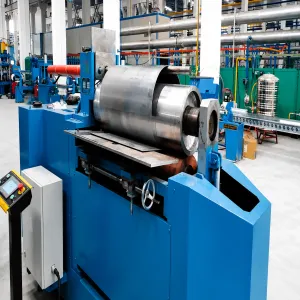
Cintreuse à deux rouleaux et quatre rouleaux
Leur classification:
Ligne de production de bouteilles de GAZ
Vues:
205
Numéro:
Temps de libération:
2026-06-22 16:49:48
Cette machine à rouler les tôles à deux rouleaux offre une productivité exceptionnelle : elle effectue un formage en une seule étape sans pré-cintrage ni traitement secondaire, avec une production quotidienne de 400 à 4 000 pièces par unité ; les variantes automatisées à grande vitesse finissent une feuille en seulement 20 secondes.
Il offre une précision de roulement de premier ordre : l'erreur de rondeur reste à ±0,4 % du diamètre de la pièce, avec une tolérance de 0,5 mm et un joint sans couture sans marques plates, surpassant les rouleaux à plaques conventionnels. Il élimine les extrémités plates résiduelles sur les pièces, réduisant ainsi le gaspillage de matériaux et améliorant l'efficacité de l'utilisation, une amélioration clé par rapport aux modèles standard à trois/quatre rouleaux.
Les rouleaux élastiques flexibles permettent un enroulement non destructif sans rayures et sans plis, s'adaptant aux feuilles perforées, gaufrées, miroir et enduites. Prenant en charge une automatisation CNC complète, il forme des lignes de production sans personnel couvrant la séparation, le chargement, le laminage et le déchargement des feuilles. Compatible avec les tôles d'acier au carbone, d'acier inoxydable et d'aluminium de 0,15 à 8 mm d'épaisseur et d'une largeur maximale de 3 000 mm. Structure simple, faible consommation d'énergie, commande électrique conforme aux normes avec protection contre les surcharges du moteur pour un fonctionnement stable et respectueux de l'environnement.
Actualités
Catégorie:
Aucun résultat de recherche!
Affaire
Catégorie:
Aucun résultat de recherche!
Vidéo
Catégorie:
Aucun résultat de recherche!
Téléchargement
Catégorie:
Aucun résultat de recherche!
Recrutement
Catégorie:
Aucun résultat de recherche!
Produits recommandés
Aucun résultat de recherche!





 English
 Español
 Pусский
 العربية



 Téléphone