Presse hydraulique à quatre colonnes
A four-post hydraulic press is a type of industrial machine widely used for shaping, forming, pressing, and assembling materials with controlled force. It is designed with four vertical posts or columns that support the upper and lower frames, creating a stable structure capable of handling high-pressure operations. This design improves strength, alignment, and durability, making the machine suitable for a broad range of manufacturing tasks.The main working principle of a four-post hydraulic press is based on hydraulic power. A hydraulic cylinder uses pressurized oil to generate force, which is then transferred to the press plate or ram. By controlling the fluid pressure, the operator can precisely adjust the pressing force, speed, and stroke. This allows the machine to perform tasks that require both high force and accurate control. Compared with mechanical presses, hydraulic presses are generally more flexible in terms of pressure adjustment and working cycle.One of the key advantages of the four-post structure is excellent stability. The four columns help guide the moving platen along a straight path, reducing tilting and ensuring even pressure distribution across the workpiece. This is especially important when pressing large, thick, or delicate materials. The rigid frame also minimizes vibration during operation, which contributes to better product quality and longer machine life.Four-post hydraulic presses are commonly used in many industries, including metal forming, plastic molding, rubber products, powder compaction, composite material processing, and assembly operations. In metalworking, they can be used for stamping, bending, drawing, straightening, and punching. In plastic and rubber processing, they are often used for compression molding and curing. In composite manufacturing, they help form materials into precise shapes under heat and pressure. Their versatility makes them a valuable tool in modern production lines.Another important feature is the large working area. The open design between the columns provides easy access for loading and unloading materials. This makes the machine convenient for handling large molds and oversized parts. Depending on the application, the press can be equipped with various accessories such as heating plates, movable worktables, pressure sensors, light curtains, and programmable control systems. These additions improve efficiency, safety, and process consistency.The operation of a four-post hydraulic press can be manual, semi-automatic, or fully automatic. Modern versions often include advanced control panels that allow operators to set pressure, time, and position with high precision. Safety systems are also essential, including emergency stop buttons, overload protection, and limit switches. These features help reduce the risk of accidents and protect both the operator and the equipment.Maintenance is another important aspect of using a hydraulic press. Regular inspection of hydraulic oil, seals, cylinders, and guide posts is necessary to keep the machine running smoothly. Proper lubrication and cleaning help prevent wear and maintain accuracy over time. With correct operation and maintenance, a four-post hydraulic press can provide reliable performance for many years.In summary, a four-post hydraulic press is a powerful, stable, and versatile machine that plays an important role in modern manufacturing. Its strong frame, precise hydraulic control, and wide range of applications make it an effective solution for many industrial pressing tasks.
Produit
Catégorie:
-
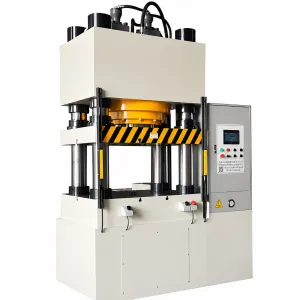
Presse à quatre colonnes
Leur classification:
Ligne de production de bouteilles de GAZ
Vues:
198
Numéro:
Temps de libération:
2026-06-22 16:13:41
1. Structure rigide à trois poutres et quatre colonnes : forte résistance aux charges excentriques, le traitement de vieillissement par vibration assure une résistance à la déformation à long terme.
2. Contrôle de pression constante/course constante PLC : trois modes de fonctionnement (réglage/manuel/semi-automatique), y compris le délai de maintien de la pression, le retour automatique et l'éjection.
3. Type d'économie d'énergie servo : 30 % à 70 % d'économie d'énergie par rapport aux modèles ordinaires, bruit <75dB et aucune fuite d'huile hydraulique.
4. Précision de guidage à quatre colonnes ± 0,1 mm : haute répétabilité, cylindre d'éjection en option, table mobile et protection photoélectrique.
Actualités
Catégorie:
Aucun résultat de recherche!
Affaire
Catégorie:
Aucun résultat de recherche!
Vidéo
Catégorie:
Aucun résultat de recherche!
Téléchargement
Catégorie:
Aucun résultat de recherche!
Recrutement
Catégorie:
Aucun résultat de recherche!
Produits recommandés
Aucun résultat de recherche!





 English
 Español
 Pусский
 العربية



 Téléphone