Four de traitement thermique pour bouteilles de gaz
A heat treatment furnace for gas cylinders is a specialized industrial heating system designed to improve the mechanical properties, safety, and service life of pressure vessels. It is widely used in the manufacturing and reconditioning of gas cylinders made of steel or other high-strength metals. The furnace plays a critical role in processes such as stress relieving, normalizing, tempering, and solution treatment, depending on the material and the required performance standards.The main purpose of this furnace is to heat gas cylinders to a controlled temperature and hold them for a specific time before cooling them under a prescribed condition. This thermal process helps eliminate internal stresses created during welding, forming, or machining. It also improves the uniformity of the metal structure, reduces brittleness, and enhances toughness and durability. For gas cylinders that must withstand high internal pressure and repeated use, heat treatment is an essential step to ensure safety and reliability.A typical heat treatment furnace for gas cylinders is designed for high efficiency, accurate temperature control, and stable operation. It usually consists of a heating chamber, insulation materials, temperature control system, loading and unloading devices, and safety protection components. The heating chamber is engineered to provide even temperature distribution so that every cylinder receives consistent treatment. The insulation layer helps minimize heat loss and reduce energy consumption. Advanced control systems allow operators to set heating curves, soaking times, and cooling schedules with high precision.There are different types of furnaces used for gas cylinder heat treatment, including batch furnaces, tunnel furnaces, and continuous furnaces. Batch furnaces are suitable for smaller production volumes or varying cylinder sizes. Continuous furnaces are ideal for large-scale production, allowing cylinders to move steadily through different heating zones. Some furnaces use electric heating, while others rely on gas firing, depending on local energy availability and cost considerations. Each type offers specific advantages in terms of productivity, temperature uniformity, and operating cost.Safety is a major concern in gas cylinder heat treatment. Since the cylinders are pressure-containing components, the furnace must be built and operated according to strict industrial standards. Overheating, uneven heating, or improper cooling can damage the metal structure and reduce the strength of the cylinder. Therefore, reliable sensors, alarms, and automatic shutdown functions are often included to prevent accidents and maintain process stability.In modern production lines, heat treatment furnaces are often integrated with automated loading systems, conveyor mechanisms, and digital monitoring tools. This improves efficiency, reduces labor intensity, and enhances process repeatability. Data logging and remote monitoring also make it easier to track temperature history and ensure product traceability.In summary, a heat treatment furnace for gas cylinders is an important piece of equipment that ensures cylinders meet strict quality and safety requirements. By providing precise and uniform thermal processing, it helps improve material properties, extend service life, and support safe use in industrial and commercial applications.
Produit
Catégorie:
-
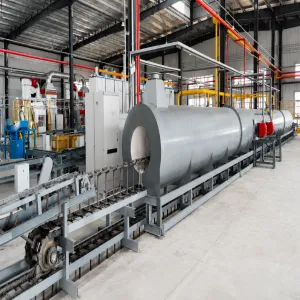
Four de traitement thermique de bouteilles de gaz
Leur classification:
Ligne de production de bouteilles de GAZ
Vues:
213
Numéro:
Temps de libération:
2026-06-22 17:08:47
1, capacité de production élevée jusqu'à 50 t/h (type balancier) ; 250 unités/h (type convoyeur à chaîne) ; couvre le recuit, la normalisation, la trempe et le revenu
2, précision du contrôle précis de la température ± 5 °C, uniformité ± 5 °C sur toute la longueur ; est conforme aux normes GB/T 9452 et TSG 07 ; La combustion pulsée zonée empêche l'impact direct de la flamme sur les pièces
3, structure de type boîte modulaire d'isolation supérieure ; Les bétons à haute température, les briques robustes et l'isolation en fibre de silicate d'aluminium garantissent une faible élévation de température du boîtier
4, système d'entraînement résistant à la chaleur, réducteur à engrenages contrôlé par VFD avec pignons et chaînes à haute température ; les supports en acier inoxydable (Φ22 mm, espacement de 150 mm) assurent une stabilité à long terme à 600°C
5, combustion efficace, brûleurs à haute vitesse de 150 000 kcal/h ; contrôle du pouls à trois zones; Le réglage précis du rapport air-carburant minimise la formation de tartre
6, PLC Siemens à contrôle entièrement automatisé avec écran tactile de 15 pouces ; Intégration DCS ; stockage et traçabilité des données ; mode de sauvegarde manuel disponible pour les anomalies automates
7 , Récupération de chaleur résiduelle et ligne intelligente La chaleur résiduelle des gaz de combustion préchauffe l'air de combustion ; compatible avec les réservoirs de trempe, les tests de dureté en ligne et le téléchargement de données pour répondre aux exigences des usines intelligentes
8 , La combustion pulsée verte et économe en énergie permet d'économiser 10 à 15 % d'énergie ; utilisation de la chaleur perdue ; prend en charge le chauffage au gaz naturel, électrique ou au gaz de houille ; aucune fuite de gaz de combustion ; Conforme ISO14000
Actualités
Catégorie:
Aucun résultat de recherche!
Affaire
Catégorie:
Aucun résultat de recherche!
Vidéo
Catégorie:
Aucun résultat de recherche!
Téléchargement
Catégorie:
Aucun résultat de recherche!
Recrutement
Catégorie:
Aucun résultat de recherche!
Produits recommandés
Aucun résultat de recherche!





 English
 Español
 Pусский
 العربية



 Téléphone