Precision Pail Manufacturing System
A precision pail manufacturing system is an integrated production setup designed to create high-quality metal or plastic pails with consistent dimensions, reliable performance, and efficient output. It combines advanced machinery, controlled processing steps, and strict quality checks to ensure that every pail meets exact specifications. Such a system is widely used in the production of packaging containers for chemicals, coatings, adhesives, food products, and industrial materials.The process usually begins with material preparation. For metal pails, steel sheets are selected, cut, and shaped into cylindrical bodies. For plastic pails, resin is melted and molded using injection or blow molding equipment. In both cases, the system focuses on accuracy from the very first stage, because even a small variation in thickness, diameter, or sealing surface can affect the final product’s durability and usability.One of the key features of a precision manufacturing system is automated forming. Machines are programmed to control pressure, temperature, and speed during shaping, which helps maintain uniform wall thickness and smooth surfaces. This improves not only the appearance of the pail but also its strength and resistance to leakage, deformation, and impact. Automated welding, curling, sealing, and lid-fitting operations further enhance consistency and reduce human error.Another important element is measurement and inspection. Modern systems often include sensors, cameras, and digital monitoring tools that check dimensions, detect surface defects, and verify assembly quality in real time. These technologies help identify problems early, reducing waste and improving production efficiency. In high-volume manufacturing, this level of control is essential for maintaining stable product quality across thousands of units.Efficiency is also a major advantage. A well-designed system can coordinate feeding, forming, trimming, handle installation, printing, and stacking in a continuous workflow. This reduces labor requirements and shortens production cycles. Many systems are also equipped with programmable logic controllers and user-friendly interfaces, allowing operators to adjust settings quickly for different product sizes or designs. This flexibility is especially useful for manufacturers that need to produce multiple pail formats on the same line.Precision pail manufacturing systems are valued for their ability to balance quality, speed, and cost-effectiveness. They support large-scale production while still meeting strict technical standards. In addition, they can be adapted for sustainable manufacturing by reducing raw material loss, lowering energy consumption, and supporting recyclable materials.Overall, a precision pail manufacturing system plays a vital role in modern container production. It enables manufacturers to deliver durable, accurate, and visually consistent pails that satisfy demanding industrial and commercial requirements.
Produit
Catégorie:
-
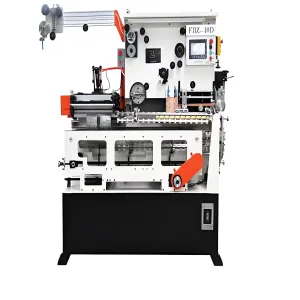
High Precision Drum Welding Production Machine
Leur classification:
Ligne de production de fûts en acier
Vues:
118
Numéro:
Temps de libération:
2026-07-04 11:47:21
The fully automatic seam welding machine is the core equipment on the steel drum production line for longitudinal lap seam welding after the steel plates of the drum body are rolled into a circle. It integrates functions such as automatic feeding, rolling, welding, flattening the weld seam, and unloading. Its working principle is based on resistance welding: after the steel plate is rolled and positioned, it is fed into the space between the upper and lower welding rollers by a servo pusher along a "Z"-shaped guide rail. The resistance heat generated by the large current (up to tens of thousands of amperes) passing through the lap joint causes the metal to locally melt to a plastic state, forming a series of continuous weld points under electrode pressure, thereby obtaining a strong and airtight weld seam. Modern fully automatic welding machines generally adopt PLC control systems and human-machine interfaces to achieve precise monitoring of the entire welding process. In terms of power supply, three-phase inverter (frequency conversion) technology is gradually replacing traditional industrial frequency AC, which has advantages such as high power factor, energy saving, and stable welding quality. After welding, a weld seam correction roller is typically used to roll the weld while it is still red-hot to eliminate lap joints and create a smooth, flat weld. This lays the foundation for subsequent processes such as flanging, rib expansion, and edge rolling.
Actualités
Catégorie:
Aucun résultat de recherche!
Affaire
Catégorie:
Aucun résultat de recherche!
Vidéo
Catégorie:
Aucun résultat de recherche!
Téléchargement
Catégorie:
Aucun résultat de recherche!
Recrutement
Catégorie:
Aucun résultat de recherche!
Produits recommandés





 English
 Español
 Pусский
 العربية



 Téléphone