four de traitement thermique
A heat treatment furnace is a specialized industrial machine used to control the heating and cooling of metal and other materials in order to change their physical and mechanical properties. It is widely used in manufacturing, metallurgy, automotive, aerospace, tooling, and other industries where precise material performance is required. By exposing workpieces to carefully controlled temperatures for specific periods of time, a heat treatment furnace can improve hardness, strength, toughness, wear resistance, ductility, and dimensional stability.The main purpose of a heat treatment furnace is to provide a stable and uniform thermal environment. Different heat treatment processes, such as annealing, quenching, tempering, normalizing, carburizing, nitriding, and stress relieving, require different temperature ranges and atmospheres. For this reason, heat treatment furnaces are designed with accurate temperature control systems, reliable insulation materials, and efficient heating elements or burners. Modern furnaces often use advanced control panels, sensors, and automated systems to ensure that temperature and time are maintained within strict limits.There are several types of heat treatment furnaces. Batch furnaces are used for processing individual loads or groups of parts at one time, making them suitable for flexible production needs. Continuous furnaces are designed for high-volume production, where materials move through the furnace in a steady flow. Other types include box furnaces, pit furnaces, vacuum furnaces, and atmosphere furnaces. Vacuum furnaces are especially important for high-precision applications because they prevent oxidation and contamination during processing. Atmosphere furnaces allow the use of protective gases to control the chemical environment around the material.The structure of a heat treatment furnace typically includes a heating chamber, insulation layer, loading system, temperature control system, and safety devices. The heating chamber must be built from materials that can withstand very high temperatures without deformation. The insulation layer helps reduce heat loss and improve energy efficiency. Temperature controllers and thermocouples monitor conditions inside the furnace to maintain accuracy. Safety systems are also essential to protect operators and equipment from overheating, gas leaks, or electrical faults.One of the key advantages of using a heat treatment furnace is the ability to improve product quality and consistency. By applying precise thermal cycles, manufacturers can produce parts with uniform properties and reduced internal stress. This leads to better performance, longer service life, and fewer defects. In addition, modern furnace designs focus on energy efficiency, lower emissions, and easier maintenance, which help reduce operating costs.In conclusion, a heat treatment furnace is an essential tool in modern industry. It provides controlled thermal processing that enhances material properties and supports the production of high-quality components. With continuous improvements in automation, temperature control, and energy efficiency, heat treatment furnaces remain vital equipment in many technical and manufacturing fields.
Produit
Catégorie:
-
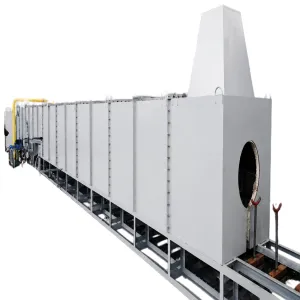
Four de traitement thermique de bouteilles de gaz
Leur classification:
Ligne de production de bouteilles de GAZ
Vues:
212
Numéro:
Temps de libération:
2026-06-21 14:24:17
Capacité de production élevée jusqu'à 50 t/h (type balancier) ; 250 unités/h (type convoyeur à chaîne) ; couvre le recuit, la normalisation, la trempe et le revenu
Précision du contrôle précis de la température ±5°C, uniformité ±5°C sur toute la longueur ; est conforme aux normes GB/T 9452 et TSG 07 ; La combustion pulsée zonée empêche l'impact direct de la flamme sur les pièces à usiner
Isolation supérieure Structure modulaire de type caisson ; les bétons à haute température, les briques robustes et l'isolation en fibre de silicate d'aluminium garantissent une faible élévation de température du boîtier
Système d'entraînement résistant à la chaleur Réducteur à engrenages contrôlé par VFD avec pignons et chaînes haute température ; les supports en acier inoxydable (Φ22 mm, espacement de 150 mm) assurent une stabilité à long terme à 600°C
Combustion efficace Brûleurs à haute vitesse de 150 000 kcal/h ; contrôle du pouls à trois zones; Le réglage précis du rapport air-carburant minimise la formation de tartre
Automate Siemens à contrôle entièrement automatisé avec écran tactile de 15 pouces ; Intégration DCS ; stockage et traçabilité des données ; mode de sauvegarde manuel disponible pour les anomalies automate
Récupération de chaleur résiduelle et ligne intelligente La chaleur résiduelle des gaz de combustion préchauffe l'air de combustion ; compatible avec les réservoirs de trempe, les tests de dureté en ligne et le téléchargement de données pour répondre aux exigences des usines intelligentes
La combustion pulsée verte et économe en énergie permet d'économiser 10 à 15 % d'énergie ; utilisation de la chaleur perdue ; prend en charge le chauffage au gaz naturel, électrique ou au gaz de houille ; aucune fuite de gaz de combustion ; Conforme ISO14000
Actualités
Catégorie:
Aucun résultat de recherche!
Affaire
Catégorie:
Aucun résultat de recherche!
Vidéo
Catégorie:
Aucun résultat de recherche!
Téléchargement
Catégorie:
Aucun résultat de recherche!
Recrutement
Catégorie:
Aucun résultat de recherche!
Produits recommandés
Aucun résultat de recherche!





 English
 Español
 Pусский
 العربية



 Téléphone